
3. How can human rights be influenced by health workers?
This guide adopts three different spheres in which health workers (can) influence human rights within the healthcare system as illustrated by the following diagram:
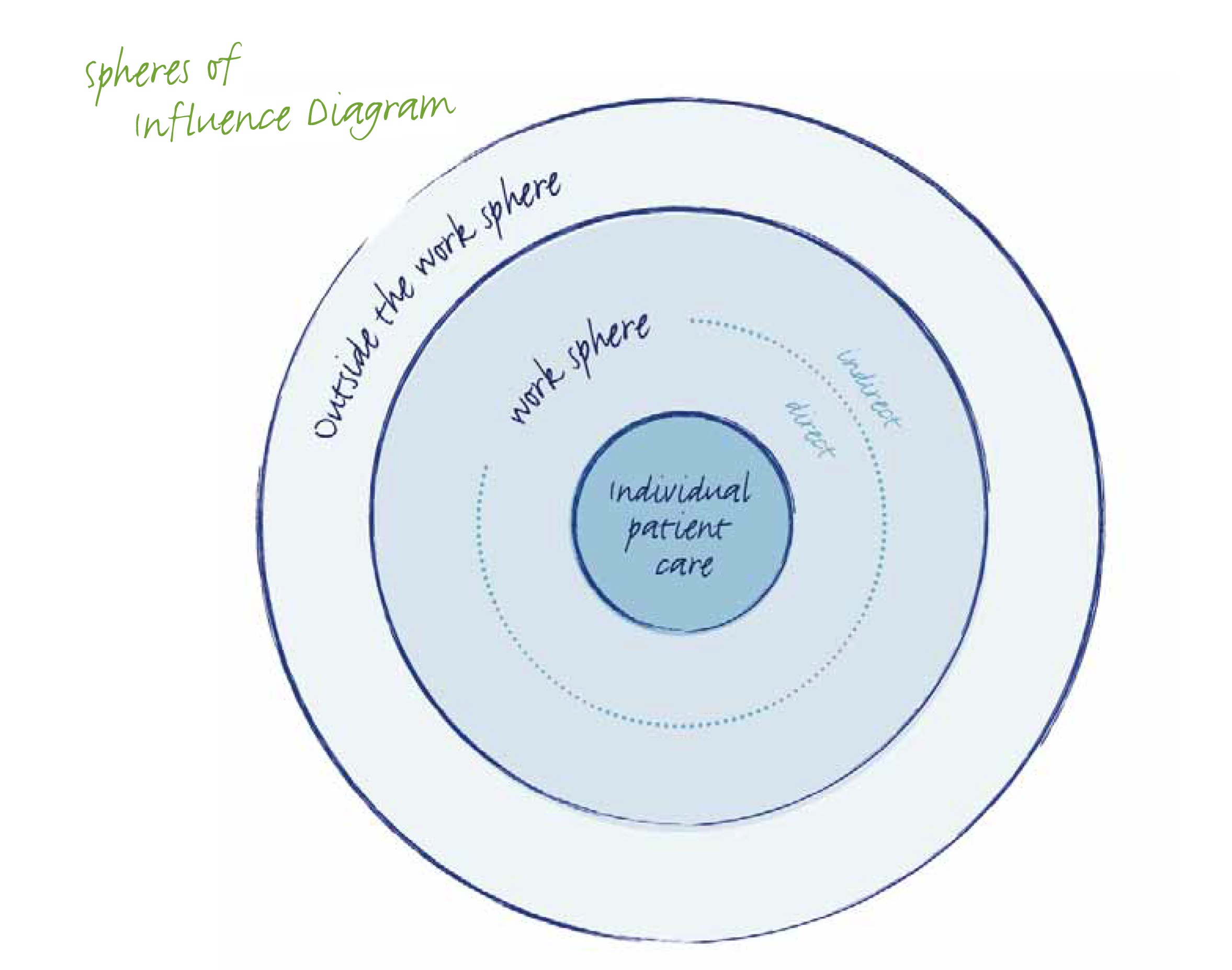
- The inner circle comprises health workers providing care to individual patients.
- The middle circle up to the dotted line (direct work sphere) covers the areas of work where a health worker is active including colleagues, superiors, patients and their families. The section past the dotted line (indirect work sphere) covers those areas of the work environment in which a health worker is not directly involved. Possible actors in this sphere are hospital management and professional associations. The exact content of the direct and the indirect work sphere will be different for each health worker, depending on position, responsibilities and professional activities.
- The outer circle includes any actors, institutions and communities that lie beyond the work sphere such as government officials, the media or society.
The primary role of a health worker lies in individual patient care. Health workers providing the highest possible standard of care are already upholding human rights. Upholding human rights in the patient care sphere includes:
- providing all necessary care without discrimination
- respecting the autonomy and dignity of all patients
- obtaining informed consent from patients before treatment
- providing all information necessary for patients’ decision-making
- respecting patient confidentiality
- taking the background of the patient into account
- maintaining professional skills at the highest possible level
The inner circle of patient care is, however, not isolated from the outside world. There can be issues both within and outside the work sphere that negatively influence human rights in patient care and create obstacles for health workers to provide the highest possible standard of care. When health workers experience pressure to comply with obligations of a third party that compromise their ability to provide the best care to the patient the situation can be described as a dual loyalty conflict.
Possible obstacles affecting human rights in patient care include:
Work sphere
- institutional rules and regulations
- lack of knowledge of health workers
- personal beliefs and attitudes of health workers
- unequal power relations between health worker and patient
- institutional discrimination
Outside the work sphere
- health laws and policies
- denial or lack of necessary resources
- societal beliefs and attitudes
The existence of such obstacles means that action in different spheres can be necessary for health workers to be able to respect human rights within their own work. Section 2 of this guide focuses on how to arrive at such points for action.
| Three examples of obstacles faced by health workers |
| A health worker is unable to adequately treat an old man with diabetes because insulin has been out of stock at pharmacies for the last months. |
| A health worker cannot provide a young woman with information about contraceptives because it is against the law to do so for unmarried couples. |
| A health worker is not able to get his patient with HIV at the top of the waiting list for kidney dialyses because people without HIV have priority. |